The 2026 ICPC South America South Finals
Sucre hosts the South America South Regional
USFX is the host site of the regional stage on 6 and 7 November 2026, with around ~90 teams from the region.
- Dates
- 6 and 7 November 2026
- Site
- USFX
- Sucre, Chuquisaca
- Teams
- ~90
- from the South America South region
Getting here means qualifying first through the two national phases. Check the criteria in the rules and the calendar in current edition .
The host university
Four centuries of academic life in the historic centre of Sucre.

Universidad Mayor, Real y Pontificia de San Francisco Xavier de Chuquisaca
USFX · Sucre
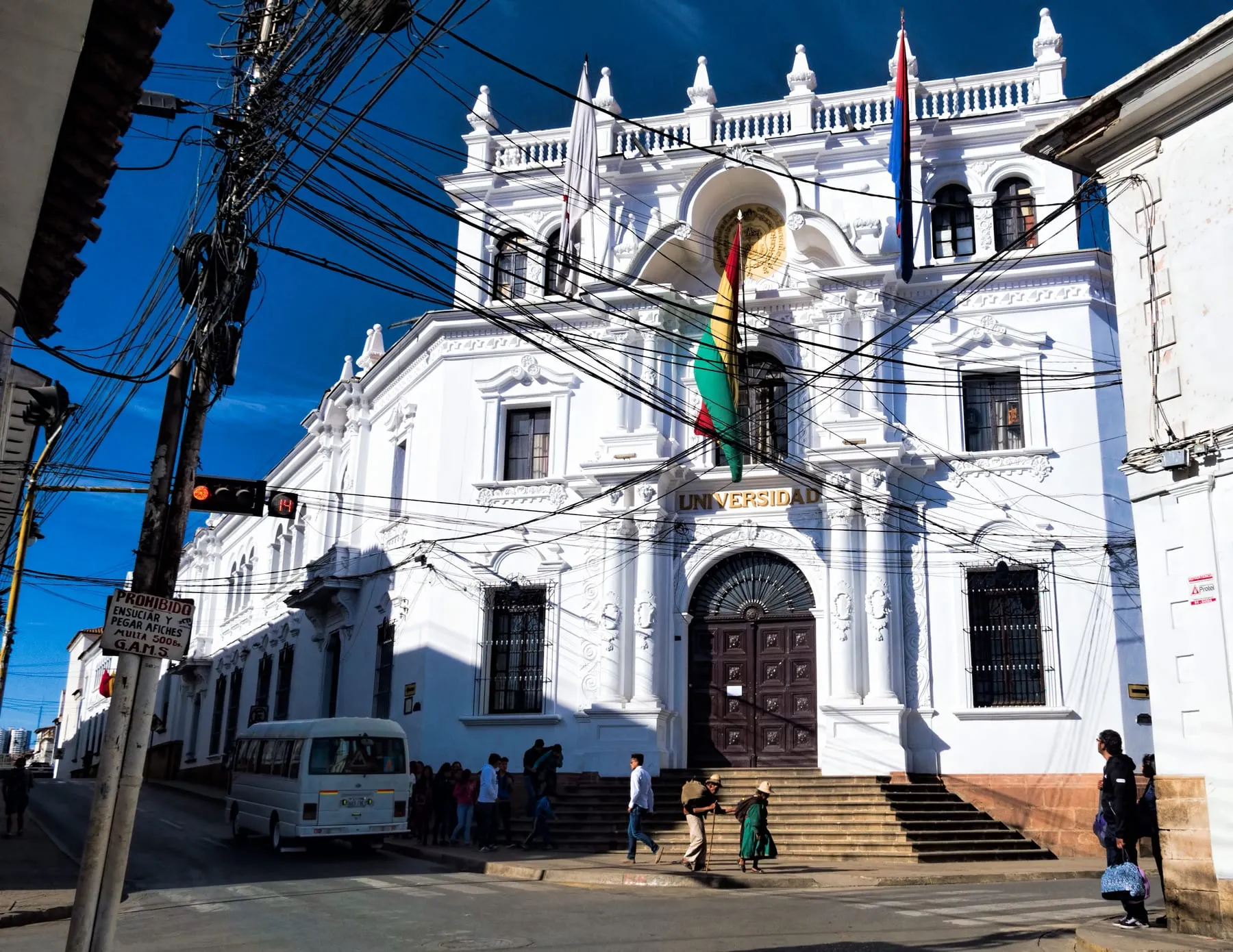
Official websiteThe Universidad Mayor, Real y Pontificia de San Francisco Xavier de Chuquisaca was founded on 27 March 1624 in what was then the city of La Plata, today Sucre. It is the oldest university in Bolivia and one of the oldest in the Americas, with four centuries of unbroken academic life celebrated in 2024.
Its lecture rooms housed the Academia Carolina (1776), a seminary of legal practice that produced a good part of the continent’s emancipatory thought: Jaime and Manuel de Zudáñez, José Mariano Serrano, Bernardo Monteagudo, Mariano Moreno and Pedro Domingo Murillo all passed through it.
The university and the city share a physical history: the Casa de la Libertad, where the Act of Independence was signed on 6 August 1825, was originally the chapel of the Jesuit complex that housed the Aula Magna of San Francisco Xavier.
- Founded
- 27 March 1624, in what was then the city of La Plata (today Sucre).
- Age
- It is the oldest university in Bolivia and one of the oldest in the Americas. It celebrated its 400 years in March 2024.
- Autonomy
- It was the first autonomous university in the country (1930-1931), with the physician and writer Jaime Mendoza as the first rector under the autonomous regime.
- Today
- A public university organised into 16 faculties grouped in four areas of knowledge.
-
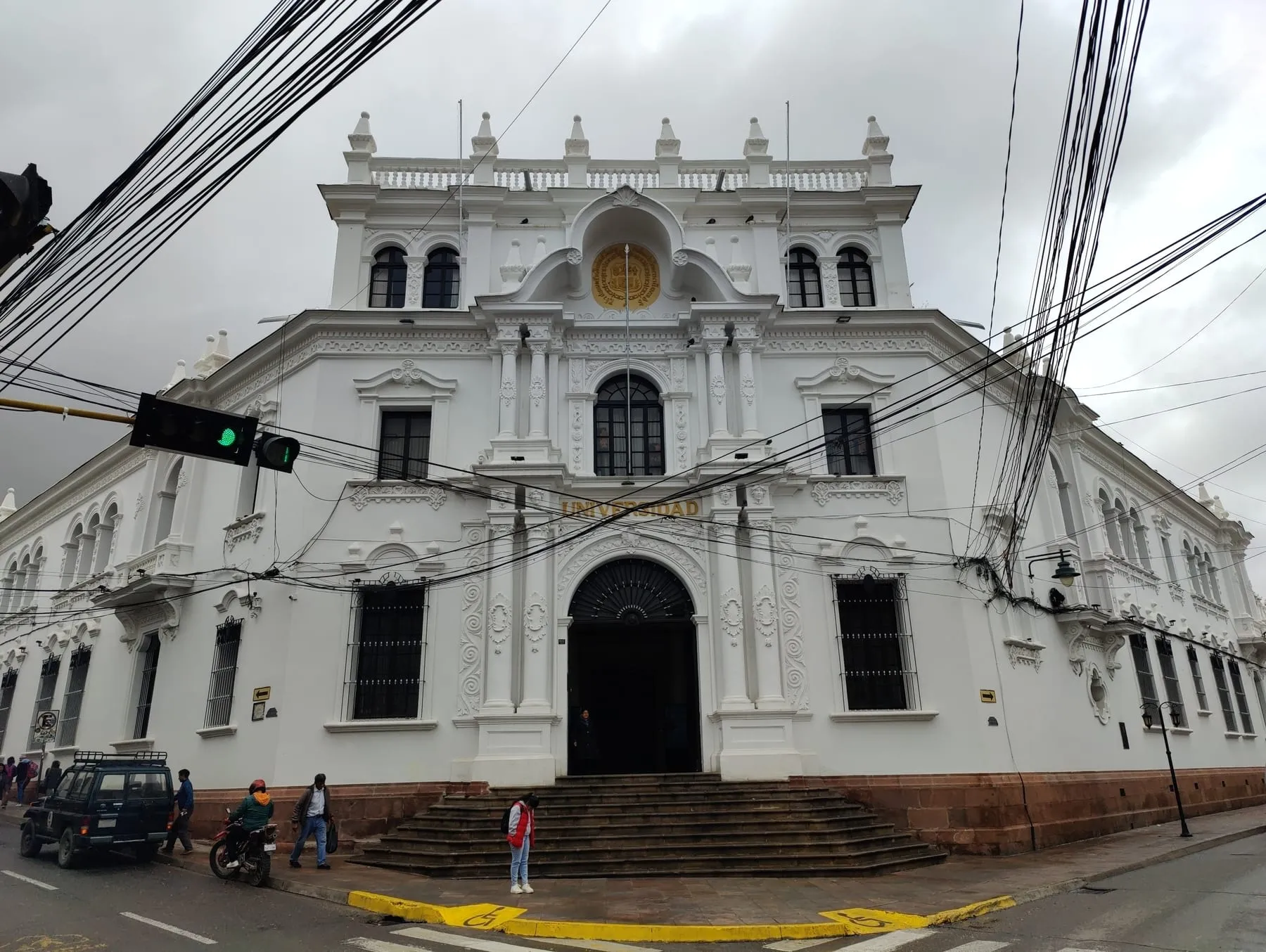
Main entrance of the USFX, on the corner of Estudiantes and Junín streets, right in the historic centre.
Sucre, the White City
Constitutional capital of Bolivia and a World Heritage Site.
Sucre is the constitutional capital of Bolivia and the seat of the Judicial Branch, the capital of the department of Chuquisaca and a city of some 297,000 inhabitants. Known as the White City for its whitewashed façades, it was the seat of the Royal Audiencia of Charcas and the setting for the signing of the Act of Independence in 1825.
Its historic centre was inscribed on the UNESCO World Heritage List in 1991, recognised as an excellent and well-preserved illustration of the architectural fusion achieved in Latin America through the assimilation of local traditions and styles imported from Europe. It is compact and walkable: churches, convents and colonial mansions a few blocks from the Plaza 25 de Mayo.
- Altitude
- ≈2,800 m
- Considerably lower than La Paz
- UNESCO World Heritage
- 1991
- Historic centre
- November
- 21-24 °C
- Nights of 9-10 °C
-
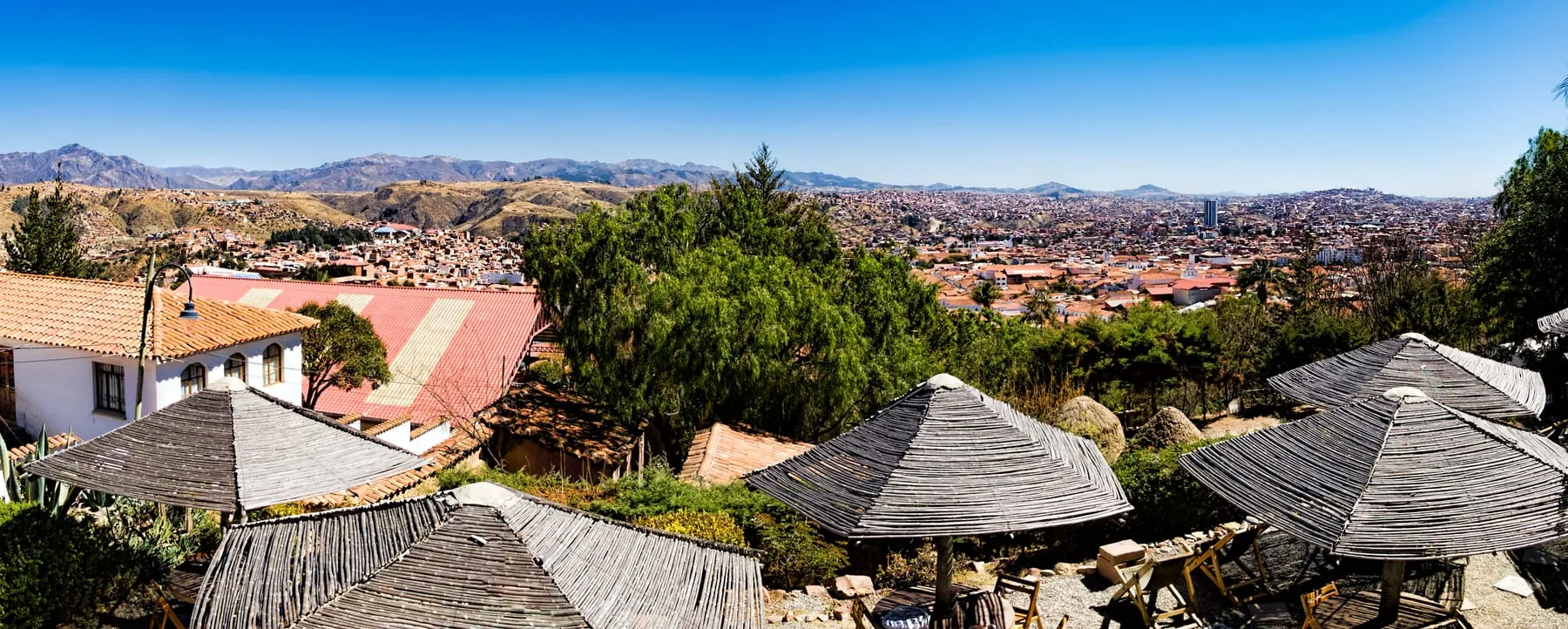
Panorama of Sucre, "the White City", from the La Recoleta viewpoint. -
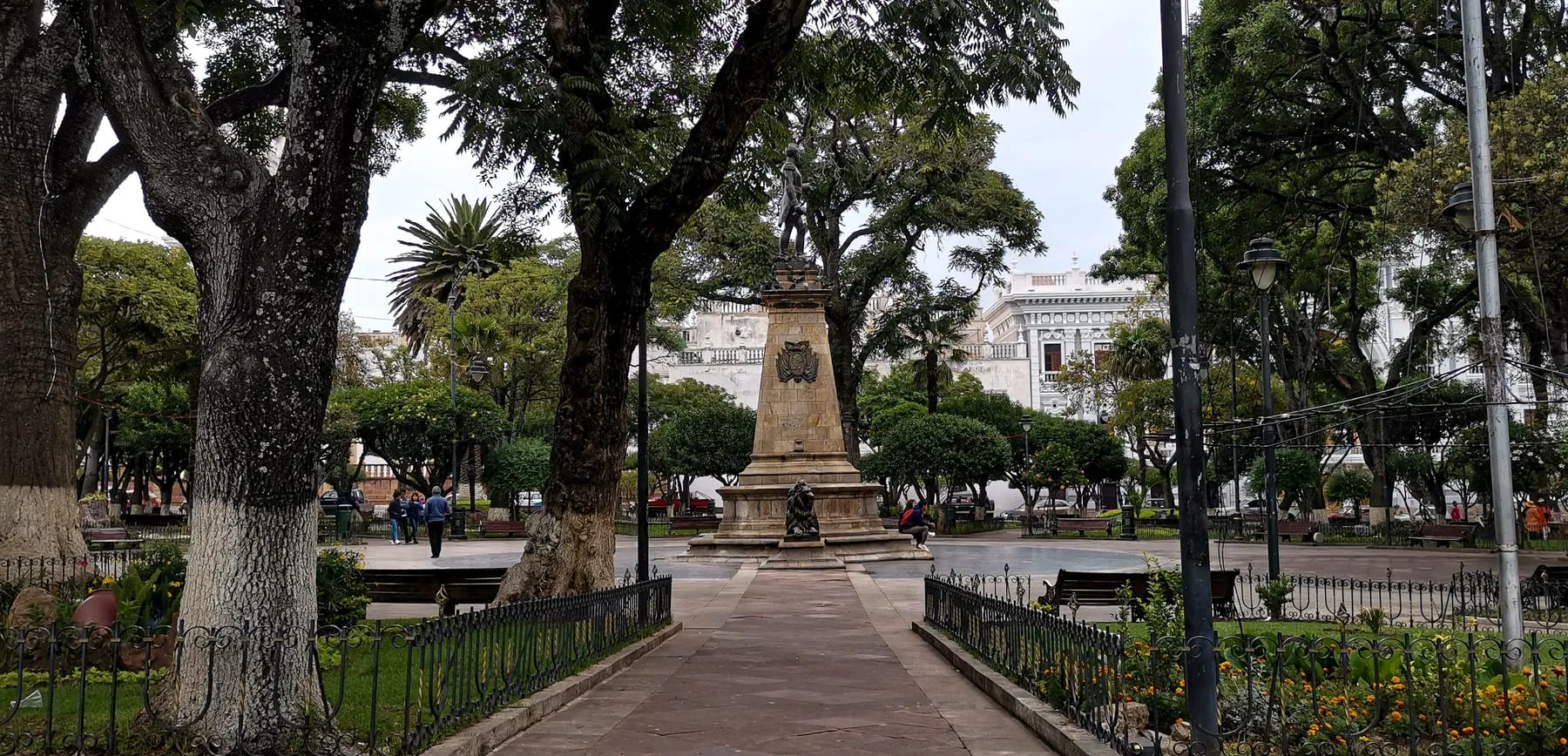
Plaza 25 de Mayo, the heart of the historic centre and the natural starting point for exploring the city. -
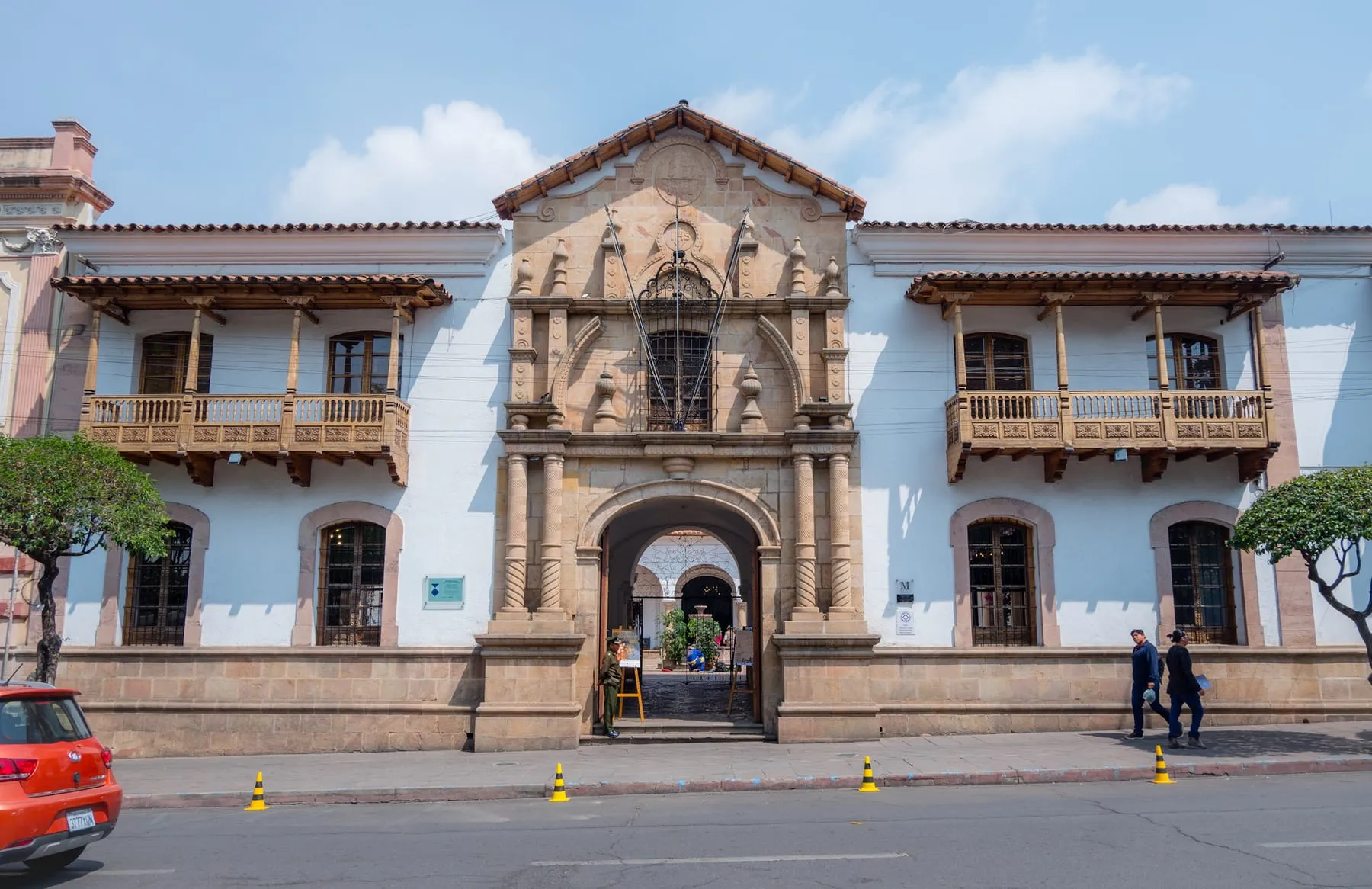
The Casa de la Libertad, where the Act of Independence of Bolivia was signed on 6 August 1825. -
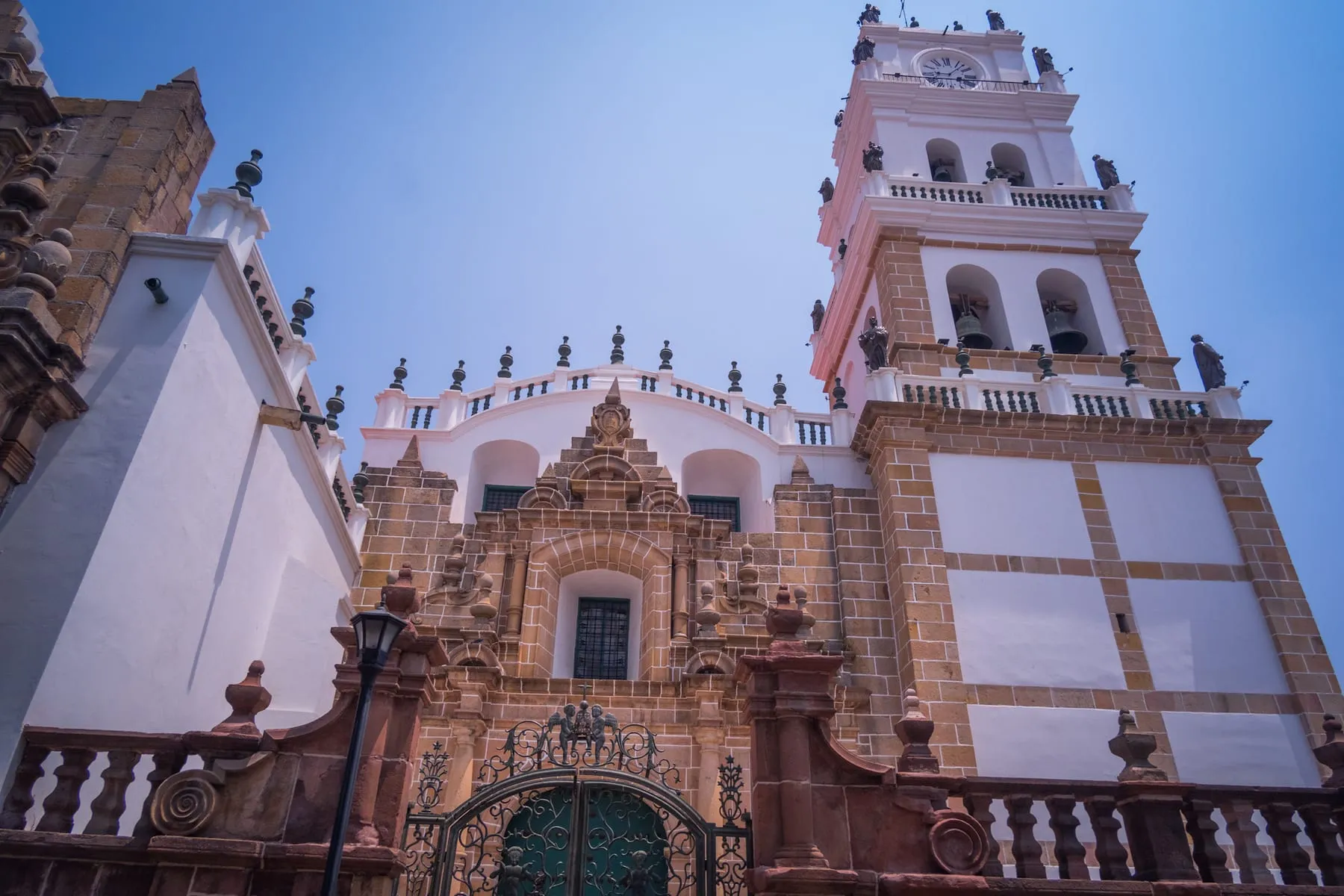
The Metropolitan Cathedral, basilica of Nuestra Señora de Guadalupe, on the Plaza 25 de Mayo. -
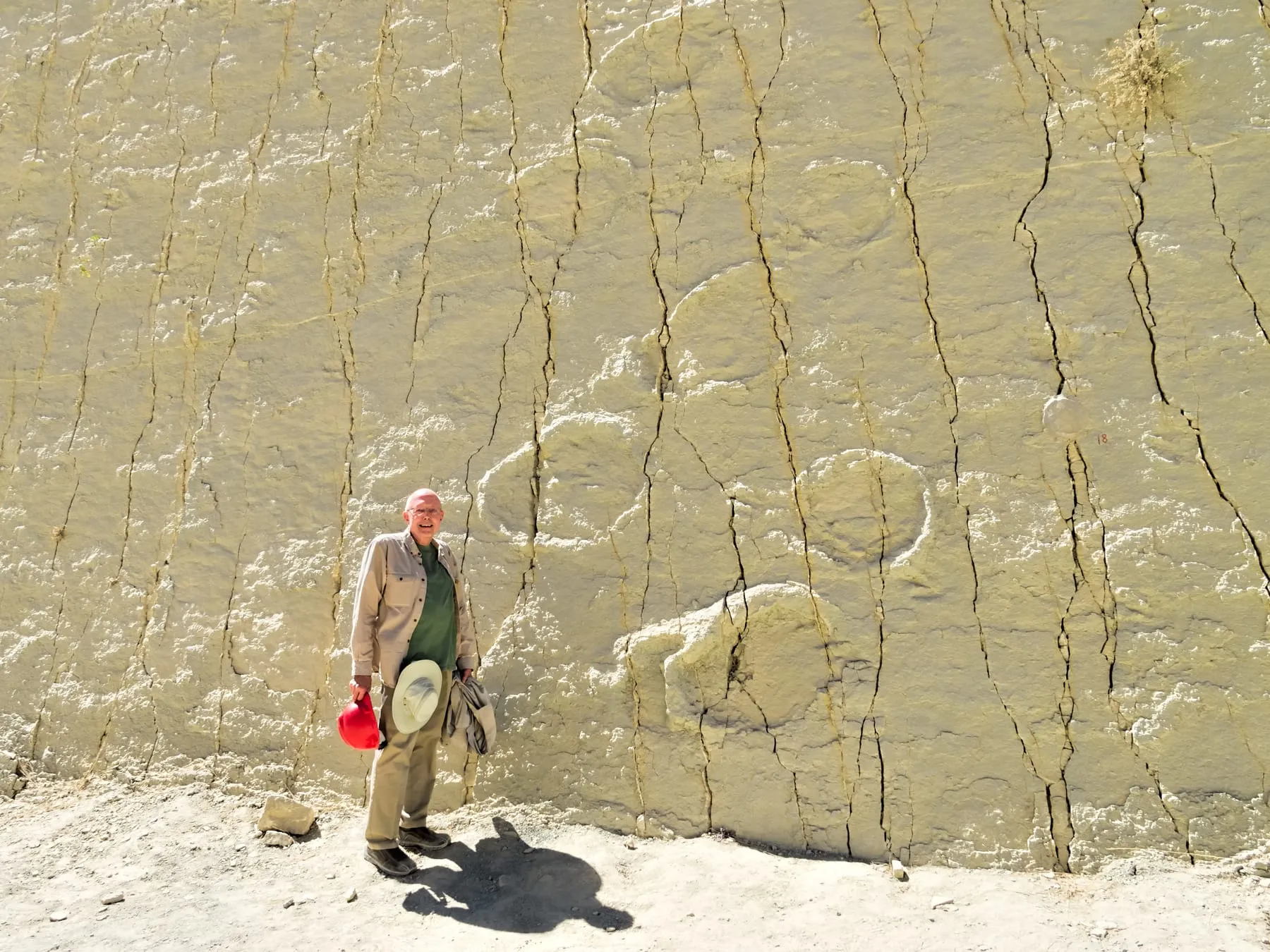
Sauropod footprints at Cal Orck’o, the most extensive site of dinosaur tracks in the world, a few kilometres from the centre. -
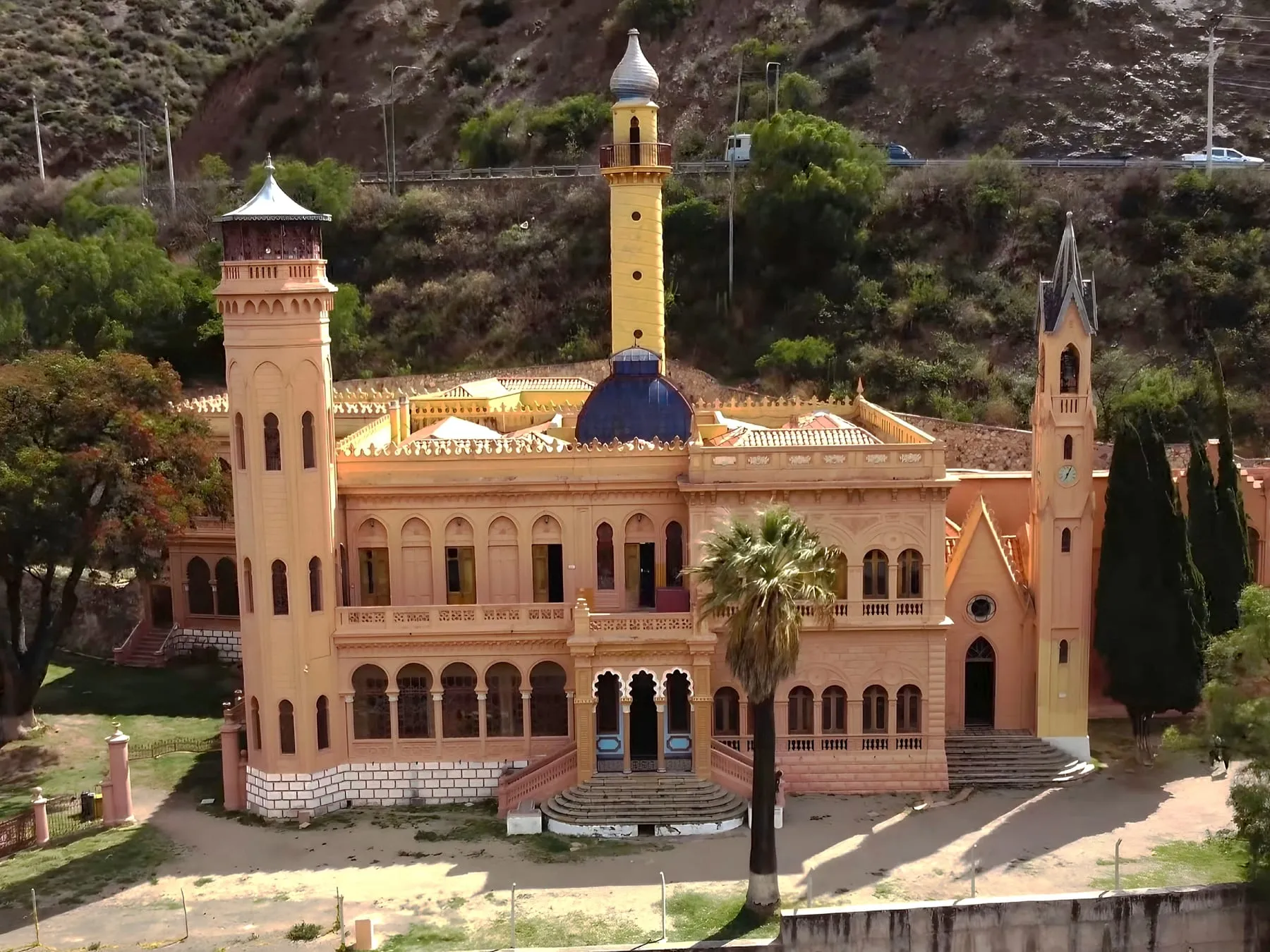
The Castillo de La Glorieta, an eclecticist palace from the late nineteenth century on the outskirts of Sucre.
What to see
Almost everything is within walking distance of the Plaza 25 de Mayo.
- Casa de la Libertad
- On the Plaza 25 de Mayo, this is the building where the Act of Independence of Bolivia was signed on 6 August 1825 and where the country’s first Constitution was drafted. It was originally the chapel of the Jesuit complex that housed the Aula Magna of the Universidad de San Francisco Xavier.
- Metropolitan Cathedral
- The basilica of Nuestra Señora de Guadalupe, on the Plaza 25 de Mayo, is one of the central monuments of the ensemble declared a World Heritage Site.
- Convent of San Felipe Neri
- A religious complex in the historic centre, much visited for the access to its terraces, from which you can take in the tile roofs and the towers of the White City.
- Monastery of La Recoleta
- A Franciscan convent on a hill south of the centre, with cloisters, a carved choir and an adjoining viewpoint that looks out over the whole city.
- Parque Cretácico — Cal Orck’o
- A few kilometres from the centre, a limestone wall that preserves more than 5,000 dinosaur footprints some 68 million years old. It is considered the largest concentration of dinosaur footprints in the world.
- Castillo de La Glorieta
- A late nineteenth-century palace on the outskirts of the city, eclecticist in architecture with towers and domes in mixed styles, built for the Argandoña family.
- Churches of San Lázaro and San Francisco
- Two of the sixteenth-century churches that UNESCO expressly cites as an example of the fusion between local building traditions and European styles.
- Tarabuco market (Sundays)
- A colonial town some 60-65 km from Sucre, a little over an hour by minibus, famous for its Sunday textile market and the traditional Yampara dress. If you compete on the 6th and 7th, Sunday the 8th is free.
Practical details
For delegations travelling to Sucre in November.
- Getting there by air
- The city is served by Alcantarí International Airport (SRE), in the municipality of Yamparáez, some 30 km from the centre: between 40 and 60 minutes by car. Plan for that transfer. The flight from La Paz takes a little over an hour.
- Getting there by bus
- Sucre is well connected by road. From La Paz the journey takes around 12 hours and from Santa Cruz around 13, generally on overnight services arriving at the terminal on Av. Ostria Gutiérrez.
- Altitude
- Sucre sits at some 2,800 m above sea level, considerably gentler than La Paz (≈3,650 m) and than El Alto airport (≈4,058 m). Even so, take it easy on the first day, keep hydrated and expect the historic centre to be hilly.
- Weather in November
- Mild days (highs of 21-24 °C) and cool nights (lows of 9-10 °C). November marks the start of the rainy season: bring layers, a light jacket, a raincoat or small umbrella, and sunscreen for the high-altitude radiation.
- Currency and cash
- The currency is the boliviano (Bs / BOB). Bolivia is still a very cash-dependent economy: arrive with bolivianos for taxis, markets and small shops, and do not assume that cards are accepted outside hotels and restaurants in the centre. Check the exchange rate with the Central Bank (bcb.gob.bo) shortly before travelling.
- Documentation
- Visa requirements vary widely by nationality. Each delegation must confirm them with the relevant Bolivian consulate well in advance; do not assume an exemption or reciprocity.
Image credits
The photographs on this page come from Wikimedia Commons and are reproduced under their respective licences, which require attribution.
- The historic central building of the Universidad Mayor, Real y Pontificia de San Francisco Xavier de Chuquisaca, founded in 1624 in the heart of Sucre — Dan Lundberg , CC BY-SA 2.0 , via Wikimedia Commons.
- Main entrance of the USFX, on the corner of Estudiantes and Junín streets, right in the historic centre — Grullab , CC BY 3.0 , via Wikimedia Commons.
- Panorama of Sucre, "the White City", from the La Recoleta viewpoint — Dan Lundberg , CC BY-SA 2.0 , via Wikimedia Commons.
- Plaza 25 de Mayo, the heart of the historic centre and the natural starting point for exploring the city — Carla Verónica Cuba Silva , CC BY-SA 4.0 , via Wikimedia Commons.
- The Casa de la Libertad, where the Act of Independence of Bolivia was signed on 6 August 1825 — Albaro2020 , CC BY-SA 4.0 , via Wikimedia Commons.
- The Metropolitan Cathedral, basilica of Nuestra Señora de Guadalupe, on the Plaza 25 de Mayo — Albaro2020 , CC BY-SA 4.0 , via Wikimedia Commons.
- Sauropod footprints at Cal Orck’o, the most extensive site of dinosaur tracks in the world, a few kilometres from the centre — Dan Lundberg , CC BY-SA 2.0 , via Wikimedia Commons.
- The Castillo de La Glorieta, an eclecticist palace from the late nineteenth century on the outskirts of Sucre — Parallelepiped09 , CC BY-SA 4.0 , via Wikimedia Commons.